

Learn when your Ontario business must register for HST, how the $30,000 threshold works, when to start charging HST, and whether voluntary registration makes sense.
One of the most common questions we hear from growing small business owners is:
“When do I need to register for HST?”
Many assume the $30,000 threshold resets every calendar year, or that they only need to register once they’ve already collected over $30,000. Neither is quite right — and getting it wrong can be costly.
In most cases, an Ontario business must register for GST/HST once its worldwide taxable revenue exceeds $30,000, either in one calendar quarter or over four consecutive calendar quarters. Here’s how that actually works, straight from the CRA’s own rules.
What is HST?
HST combines the 5% federal GST with Ontario’s provincial portion, for a combined rate of 13%. Once registered, you charge it on taxable sales, collect it from customers, and report it to the CRA.
The HST you collect is not business income — you’re holding it on behalf of the government, so it should be tracked separately in your books until it’s remitted.
What is a “small supplier”?
The CRA considers you a small supplier when your revenue from worldwide taxable supplies is no more than $30,000, both in one calendar quarter and over the last four consecutive calendar quarters. While you’re a small supplier, registration is optional.
This calculation includes the combined revenue of your business and any associated persons, and generally excludes exempt supplies, capital property sales, financial services, and goodwill from a business sale.
What counts toward the $30,000? All taxable revenue, before expenses — including zero-rated supplies (like exports), which count toward the threshold even though they’re taxed at 0%. Exempt supplies (certain health, education, financial, and residential rental services) generally do not count.
The threshold isn’t just a calendar-year count
The CRA applies two separate tests, and either one can trigger registration:
- Did you exceed $30,000 in one calendar quarter?
- Did you exceed $30,000 over four consecutive calendar quarters (a rolling window, not a fixed year)?
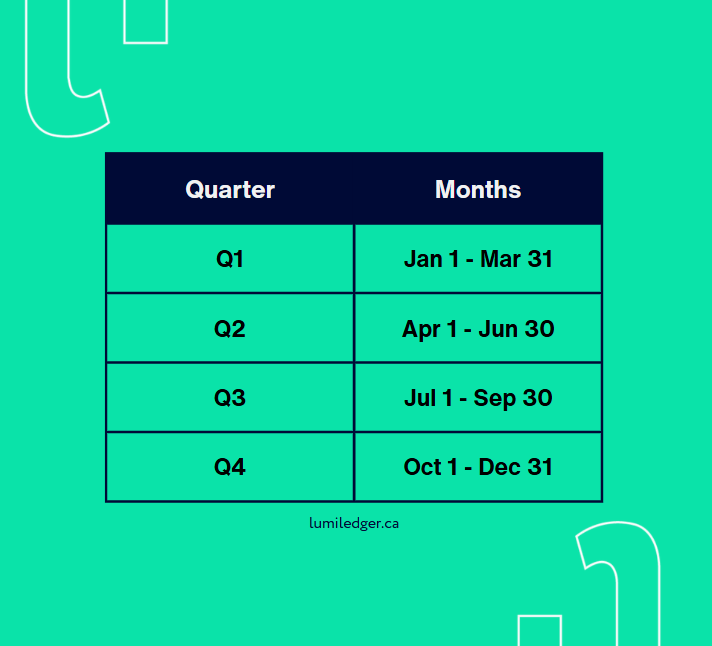
The four-quarter test moves forward every quarter, so it needs ongoing tracking — not just a check at year-end. Exactly $30,000 doesn’t trigger it; the rule kicks in once you exceed that amount.
Scenario 1: You exceed $30,000 in one quarter
| Month | Revenue |
| January | $8,000 |
| February | $11,000 |
| March | $15,000 |
| Total | $34,000 |
You stop being a small supplier the moment the sale that crosses $30,000 happens. Your effective registration date is no later than that sale’s date, and you must charge GST/HST on the entire sale that pushed you over — not just the portion above $30,000. You then have 29 days to register.
Scenario 2: You exceed $30,000 over four consecutive quarters
| Calendar quarter | Revenue | Cumulative |
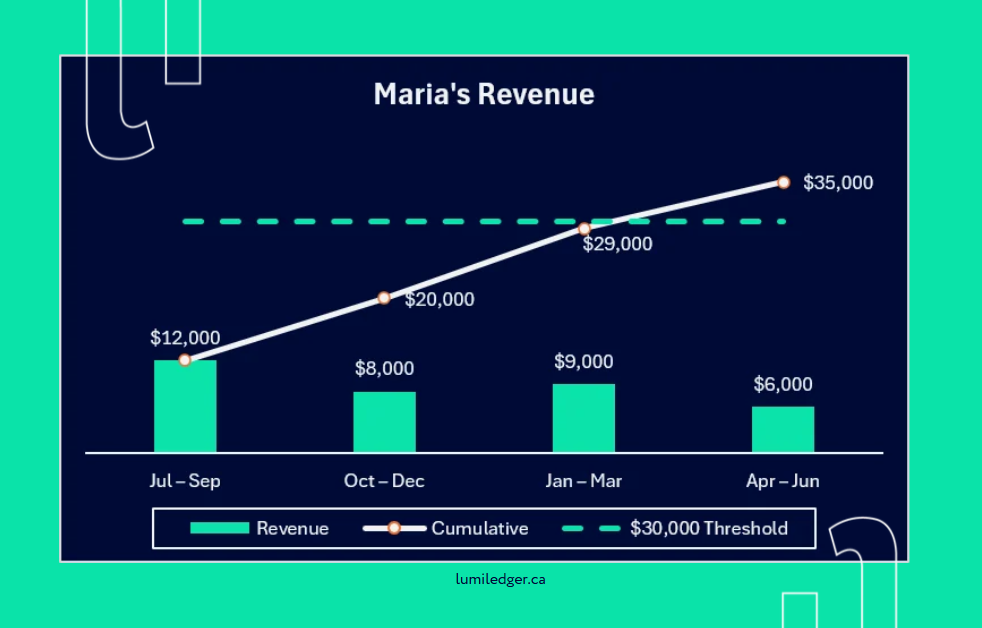
| Jul – Sep | $12,000 | $12,000 |
| Oct – Dec | $8,000 | $20,000 |
| Jan – Mar | $9,000 | $29,000 |
| Apr – Jun | $6,000 | $35,000 |
No single quarter hit $30,000, but four consecutive quarters totalled $35,000. Here, you stop being a small supplier at the end of the month following the quarter you crossed the threshold — in this case, end of July. Your effective registration date is your first taxable sale after that.
Maria’s story: Maria is a marketing consultant working with small businesses across Ontario. She watched her bank balance, not her quarterly totals — so by the time she checked her last four quarters, she’d already crossed $30,000 two months earlier without registering. She ended up owing HST she’d never charged her clients. A simple monthly review against the rolling four-quarter total would have caught it in time.
Should you register before you have to?
You can register voluntarily even as a small supplier — worth considering if you have significant startup costs, buy inventory or equipment, mostly invoice other GST/HST-registered businesses, or expect to cross the threshold soon.
Registering lets you claim input tax credits (ITCs) — recovering GST/HST paid on eligible business purchases. For example: $1,300 collected in HST minus $400 in ITCs means $900 net remitted to the CRA.
It also means ongoing obligations: charging tax, filing returns, and generally staying registered at least one year before cancelling.
Registered but still under $30,000 — do you still have to remit?
Yes. Once you’re registered, the small-supplier exemption no longer applies, no matter your revenue. Registration — not revenue — is what creates the obligation.
That means: you must charge and collect GST/HST on taxable sales from your effective date forward; if you didn’t charge it, the CRA can still require you to remit it out of pocket; you must file returns (even “nil” ones) for every period; and you generally can’t cancel your registration for at least a year.
If your revenue never grew the way you expected, talk to your bookkeeper or the CRA about formally cancelling — don’t just stop charging tax on your own.
Can you charge HST before you’re registered?
No — determine your effective registration date and complete registration first. If you were required to register but missed the date, the CRA can backdate your registration, meaning you could owe GST/HST on past sales even if you never collected it.
Exceptions to the $30,000 rule
Some businesses must register regardless of revenue — taxi and commercial ride-sharing drivers, for example, from day one. Different thresholds also apply to charities and public institutions, other public service bodies, non-residents (including digital-economy and short-term accommodation platforms), and businesses associated with other corporations. If any of these apply to you, confirm your specific obligation with your bookkeeper or the CRA.
How often do you file?

Most sole proprietors filing annually with a December 31 year-end have two different deadlines: payment is due April 30, but the return itself is due June 15. Filing later doesn’t extend the payment deadline.
How to stay ahead of it
Track taxable, zero-rated, and exempt revenue separately Review revenue monthly, and check it against the last four rolling quarters Keep business and personal transactions separate Set aside collected HST rather than treating it as cash on hand Talk to your bookkeeper before you cross the threshold, not after
Clarity before complexity
HST registration feels complicated, but the first step is simple: know your taxable revenue and review it regularly. Clear books mean you see the threshold coming — clarity, control, and confidence in your numbers, instead of a scramble later.
Not sure whether you’re approaching the HST threshold? Contact LumiLedger — we’ll help you stay ahead of it.
This article provides general information and is not tax or legal advice. GST/HST rules can vary by business, supply type, customer location, and other factors. Consult the CRA or a qualified tax professional about your specific situation.