

If you’re running a small business in Ontario, chances are you picked a business structure early on — maybe without thinking too much about it — and just got to work. That’s completely normal! But the structure you chose (or the one you’re considering now) quietly shapes almost everything about your bookkeeping and your taxes. And honestly, this is one of the questions I get asked the most.
So let’s walk through it together, using a simple example: Maria, an independent marketing consultant working with small businesses across Ontario. We’ll follow her business as it grows, and use her story to show what changes — and what doesn’t — as you move from one structure to another.

Starting Out: Maria the Sole Proprietor
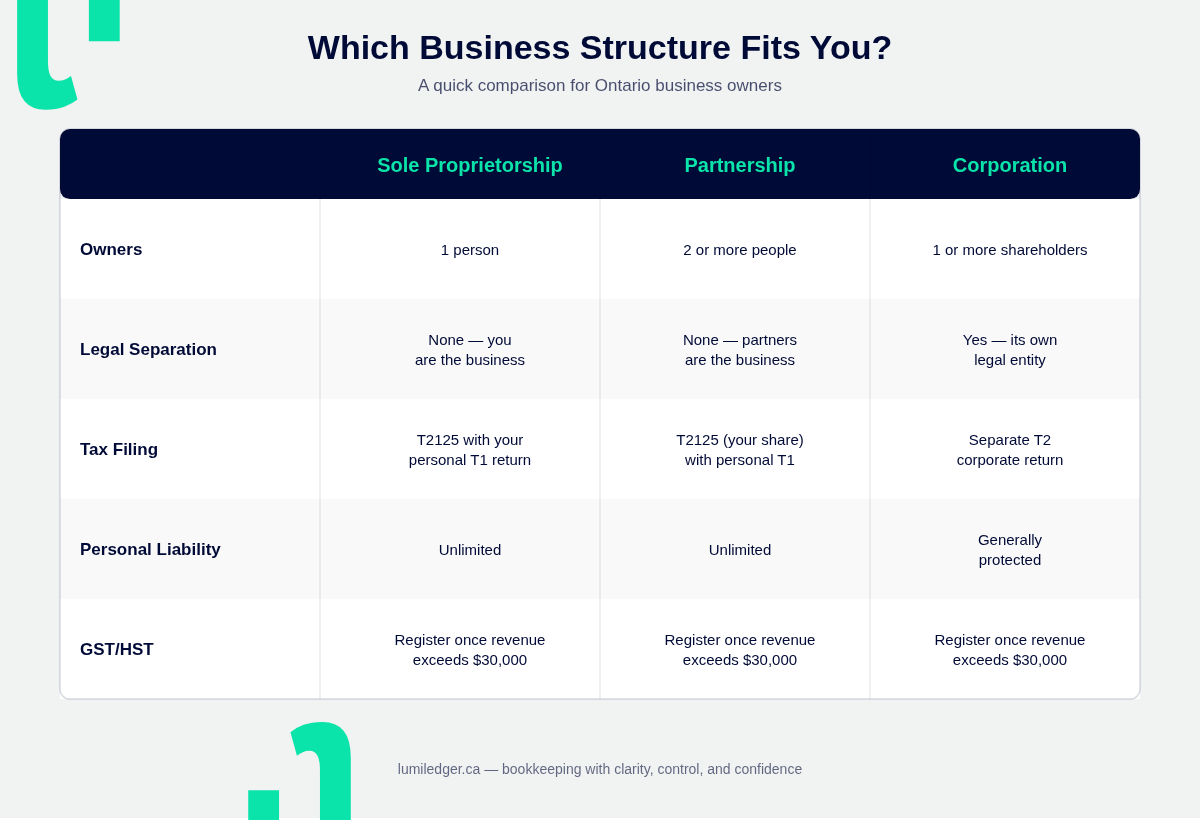
When Maria first started taking on consulting clients, she didn’t incorporate anything or file any special paperwork. She just started sending invoices. That’s a sole proprietorship — the simplest and most common way to start a business in Canada. Legally speaking, there’s no separation between Maria and her business. She is the business.
Here’s the part I really want you to take away: because there’s no legal separation, everything Maria earns and spends on her consulting work ends up on her personal tax return, using a form called T2125 (Statement of Business or Professional Activities). Her profit gets added to her other income and taxed at her personal rate. If she has a slow year, that loss can actually help lower her overall tax bill — which is a nice little silver lining.
But — and I say this to almost every sole proprietor I work with — just because there’s no separate corporate filing doesn’t mean you can be loose with your records. I always tell clients: keep your business money and your personal money in separate bank accounts, even if you’re “just” a sole proprietor. Maria used to pay for her software subscriptions and client lunches with whatever card was in her wallet, and by tax time she genuinely couldn’t remember what was for the business and what wasn’t. That’s a headache I’d love to save you from.
One more thing worth flagging: once Maria’s revenue crosses $30,000 over four consecutive quarters, she’s required to register for GST/HST and start charging it on her invoices. This trips up a lot of self-employed folks because it happens quietly — nobody sends you a letter reminding you the moment you cross the line.
Growing Together: Maria and a Business Partner
A couple of years in, Maria decides to team up with another consultant who specializes in something she doesn’t — say, web design — so together they can offer clients a fuller package. Now we’re talking about a partnership — two (or more) people sharing ownership.
The good news: partnerships are just about as easy and cheap to set up as a sole proprietorship. The important thing I always push clients toward here is a written partnership agreement. It’s not legally required, but I’ve seen what happens without one — disagreements over who gets what share of the profits, who’s responsible for which expenses, and it’s just so much easier to sort that out on paper before there’s real money and real stress on the table.
For taxes, the partnership itself doesn’t pay tax. Instead, the profit or loss gets split between Maria and her partner according to their agreement, and each of them reports their own share on their personal tax return, again generally using that same T2125 form. This is where clean bookkeeping really starts to matter — I need to be able to show, clearly, exactly how much revenue and which expenses belong to the partnership as a whole, so the split between partners is fair and defensible if the CRA ever asks.
Like a sole proprietorship, a partnership still carries personal liability for the partners, and the same $30,000 GST/HST threshold applies.
Leveling Up: Maria Incorporates
Fast forward a few more years. Maria’s consulting practice is doing really well, she’s brought on a couple of contractors to help with the workload, and her bookkeeper (hi!) suggests it might be time to incorporate. This is a bigger step, and I want to be upfront with you: it comes with real benefits, but also real responsibility.
When you incorporate, you create a business that’s legally its own thing, separate from you. It can be sued, it can owe money, and — this is the part people love — your personal assets are generally protected if something goes wrong with the business. Maria’s corporation now has its own CRA business number and has to file its own T2 Corporate Income Tax Return every single year, whether it made money or not.
Here’s the tradeoff I always walk clients through: corporations often get access to a lower tax rate on active business income through the small business deduction, which is genuinely great. But the bookkeeping expectations go up a notch too. I tell incorporated clients: think of the corporation as its own separate “person” with its own bank account, its own books, its own everything. If you start paying yourself from the corporation — whether as a salary or as dividends — that needs to be tracked properly too, and if it’s a salary, you’re now managing payroll remittances and T4 filings as well.
And yes, GST/HST still applies the same way once revenue crosses $30,000.
So… Which One Is Right for You?
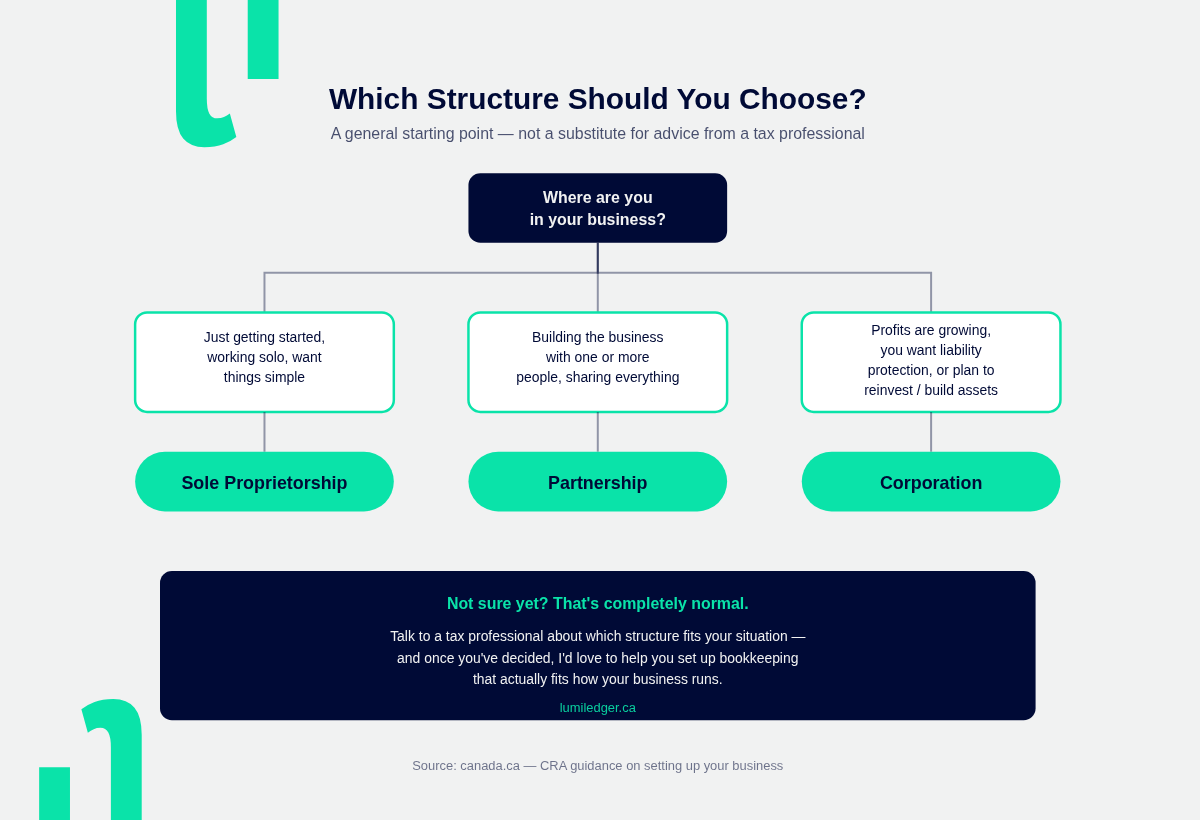
Honestly? It depends. There’s no single best answer, and what’s right for Maria might not be right for you. It usually comes down to how much you’re earning, how much risk you’re comfortable carrying personally, how much administrative work you’re ready to take on, and your medium to long-term plans to build assets. A lot of the business owners I meet start simply as a sole proprietor, and that’s often exactly the right call — there’s no rush to incorporate just because it sounds more “official.” Incorporating tends to make the most sense once profits grow enough that the tax savings and liability protection outweigh the extra paperwork.
The One Thing That Stays True No Matter What
Whichever path you’re on — sole proprietor, partnership, or incorporated — here’s the thing I want you to remember: the CRA always expects clean, complete, well-organized records behind whatever you file, whether that’s a T2125 or a full T2 return.
The structure changes the paperwork. It doesn’t change the need for good books.
And that’s really where I come in. I’d much rather help you keep things organized month to month than help you dig through a shoebox of receipts the week before your deadline (I promise, we’ve all been there — no judgment). Clean books all year long means tax time is just a formality, and it means you actually know how your business is doing, not just guessing.
The structure decision itself is best made with a tax professional. But once that’s settled, that’s my cue — I’d love to help you set up bookkeeping that actually fits how your business runs.
This article is meant to give you a general, plain-language starting point — it isn’t personalized tax or legal advice. For guidance specific to your situation, it’s always worth a conversation with a professional, or you can check the CRA’s own guidance on setting up your business.